
Governance
Configure fix approvals, protected paths, and account settings in one place.
Security commentary
Why model refusal behaviour and application security need separate evaluation.
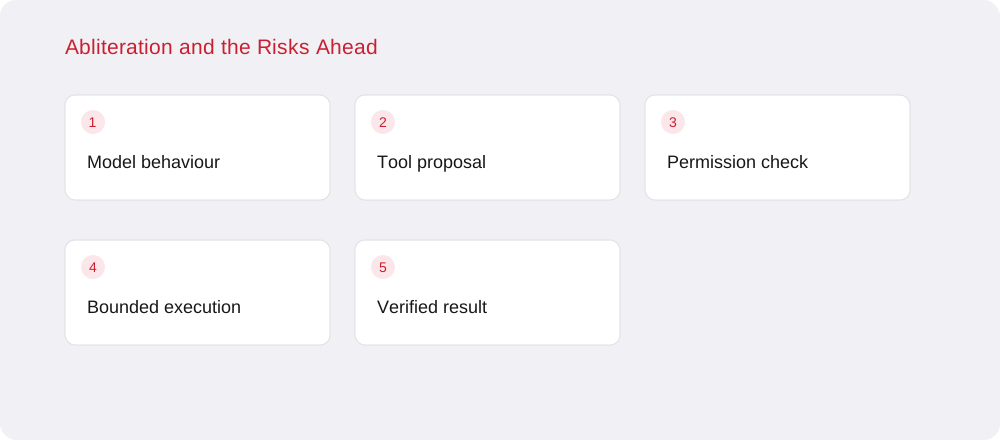
Abliteration is commonly used to describe techniques intended to reduce a model's refusal behaviour by changing its internal representations or weights. The term covers methods with different effects, so it should not be treated as a precise measurement of capability. A model that refuses fewer requests has not necessarily become better at completing them. Conversely, the presence of a refusal does not prove that an application remains protected when another model, tool or workflow is substituted.
For defenders, the useful distinction is between a model's willingness to propose an action and the surrounding system's authority to execute it. An application should not depend on a remote model consistently declining a dangerous request to protect a sensitive operation.
Evaluate actions and results rather than alarming wording. In an authorised test environment, define the information available to the agent, the tools it can access and the outcome being measured. Record whether it produced an unsupported suggestion, attempted an operation or actually crossed a boundary. Those are different results. A convincing explanation is not evidence of a successful compromise, just as a failed attempt is not proof that a vulnerability is absent.
Keep the model version, configuration, tool definitions and test inputs with the result. If any of them change, the earlier conclusion may no longer describe the deployed system. This matters when the same assistant can be routed to multiple providers or updated without a code release.
A database tool should enforce its own allowed operations and account scope. A file tool should restrict the directories it can access. A network policy should constrain destinations even if the agent discovers another way to make a request. Where a workflow needs approval, bind that approval to the specific action and destination rather than a broad conversational intention. Changing the model should not silently expand any of these capabilities.
Retrieved documents, dependency readmes and tool responses also need a trust boundary. They may contain text that looks like an instruction. Preserve them as data and avoid allowing their claims to grant new permissions. A model's safety training can support this boundary, but it cannot replace enforcement at the execution layer.
Test a small set of scenarios in which the model proposes the wrong action, a tool returns manipulated content or a policy service is unavailable. The desired result is an observable rejection, a safe pause or a constrained fallback. If a failed model call causes the application to use a more permissive path, availability handling has become a security decision and deserves its own review.
Use the results to prioritise controls that continue to work across model changes: narrowly scoped identities, durable audit events, explicit output validation and recoverable changes. The objective is resilience when a model behaves differently from expectations. Treat safety research as valuable evidence, while keeping the application's security properties independently testable.
Configure fix approvals, protected paths, and account settings in one place.

Review findings and fix activity in one place, with finding exports available.

Review recorded scan activity and finding state changes.

Account membership controls access to connected repositories and findings.

Bring your own encryption key. Your data stays encrypted with keys you control.