
Governance
Configure fix approvals, protected paths, and account settings in one place.
Security commentary
A practical intake and validation process for vulnerability reports in an automated reporting era.
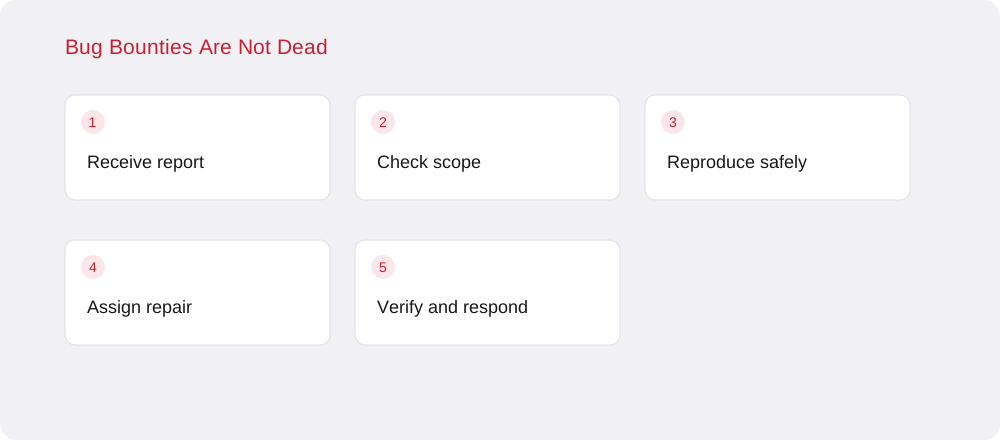
A vulnerability report is useful when it identifies a reproducible security failure in a system you operate. Its length, formatting or apparent sophistication does not establish that failure. Automation can help a researcher investigate an issue and can also make weak reports easier to produce. The defensive response should focus on evidence quality and triage capacity rather than trying to infer how the report was written.
A workable programme needs a clear scope, a reliable contact route and a defined process for acknowledgement, investigation and remediation. A bounty is one possible incentive within that process. It does not replace the engineering work needed to decide whether a claim is valid.
Request the affected asset, a concise description of the boundary being crossed, the account privileges required and steps that demonstrate the result. Ask the reporter to minimise sensitive data and avoid unnecessary access. A report about another user's records should be reproducible with controlled accounts and synthetic records wherever possible. Keep attachments quarantined; supplied scripts and binaries are untrusted evidence, not instructions that should be executed automatically.
Deduplicate reports using the root cause and affected component, not just a similarity score over prose. Two reports with different endpoints may share one missing permission check. Two similar-looking screenshots may represent distinct issues. Preserve the link between the original report, its evidence and the investigator's conclusion.
Before reproducing a report, check that the target is owned or authorised, identify the relevant revision and select the least disruptive test. If the report depends on account roles, use separate test identities and document their permissions. Establish a baseline request that should succeed and a negative request that should fail. Comparing those outcomes makes an authorisation finding easier to assess than inspecting a single response in isolation.
Return distinct verdicts: confirmed, not reproduced under the stated conditions, duplicate, out of scope or awaiting information. A failed reproduction does not always invalidate the report; a configuration difference or missing prerequisite may explain it. State what was tested and what remains unknown.
Give each confirmed issue an owner, a severity rationale and a remediation plan. Link the repair to the original evidence and rerun the narrow test after deployment. Also exercise the legitimate workflow so the fix does not simply disable a necessary feature. Share enough status with the researcher to keep coordination productive, without exposing internal credentials or other customers' data.
Useful programme measures include time to first meaningful response, time to reproducible verdict and time to verified remediation. Report volume alone is a poor success metric. A small queue of well-validated issues can be more valuable than a large pile of unexamined alerts. Human judgement, disciplined evidence and bounded automation can all contribute to that outcome.
Configure fix approvals, protected paths, and account settings in one place.

Review findings and fix activity in one place, with finding exports available.

Review recorded scan activity and finding state changes.

Account membership controls access to connected repositories and findings.

Bring your own encryption key. Your data stays encrypted with keys you control.