
Governance
Configure fix approvals, protected paths, and account settings in one place.
Security commentary
Match review methods to the security property being checked and judge findings by evidence rather than volume.
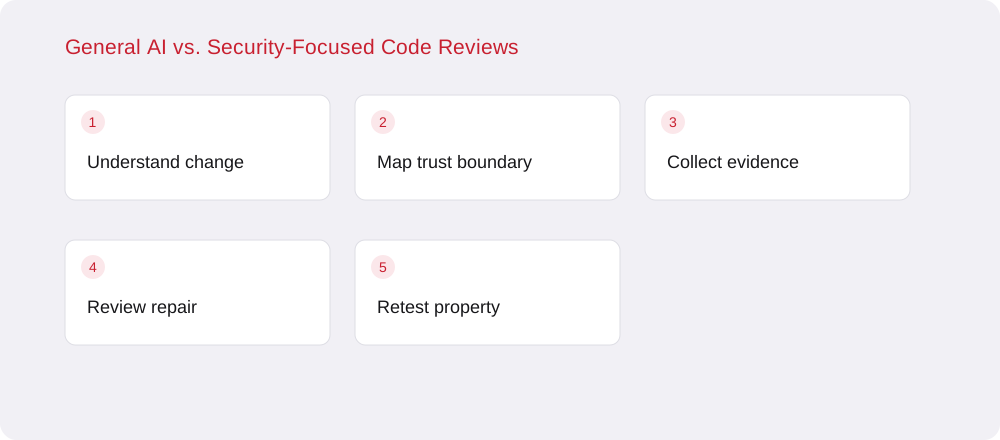
A general code review may assess readability, maintainability, likely defects and consistency with surrounding code. A security-focused review asks how a change affects trust boundaries and misuse. Neither label guarantees a particular result, and a single system can support both kinds of work. The useful distinction is the task definition and the context available to the reviewer, rather than a claim that one category always outperforms the other.
For a pull request that exports account data, general review may catch a missing error handler. Security review should also ask who can request the export, whose records are selected and whether the result is delivered to an authorised destination. Those questions require understanding intended access, not only the changed syntax.
Give the reviewer the entry point, caller identity, data classification and important invariants. Identify shared permission helpers, tenant filters and background processing used by the changed code. An endpoint can look consistent with neighbouring endpoints while repeating the same missing authorisation check. Conversely, a suspicious-looking operation may be protected by a verified boundary elsewhere in the execution path.
Ask each finding to state the violated property, the affected code and the conditions required for impact. A useful example is that a low-privilege user can access another tenant's synthetic record through a particular request. A vague warning that an operation is sensitive does not give the developer enough information to decide whether a fix is needed.
Static queries can trace classes of data flow and identify recurring code patterns. Human or model-assisted reasoning can investigate application-specific meaning and missing context. Runtime tests can validate selected behaviours in an authorised environment. Keep these evidence types distinct. A model's explanation of a possible path is not the same as a path produced by an analysis tool or an observed unauthorised response.
For a proposed repair, check that the permission decision happens at the correct boundary and applies to every relevant path. Avoid a patch that adds a check only to the visible web route while leaving the same operation reachable through a job or alternate API. Preserve regression tests that exercise both an allowed identity and a forbidden identity.
Compare approaches using the same repository context, changes and review budget. Include confirmed security issues, ordinary maintenance changes and examples that should not be flagged. Have an independent reviewer assess correctness, clarity and the effort required to reproduce each finding. Counting all comments together can reward repetitive warnings and style suggestions without improving security decisions.
Track missed issues as well as false positives, and inspect whether findings lead to verified repairs. A specialised workflow earns its place when it provides useful evidence about important security properties. A general assistant remains valuable where its context and checks are sufficient. The goal is a review process that helps engineers preserve the application's boundaries, with a clear account of what each method actually established.
Configure fix approvals, protected paths, and account settings in one place.

Review findings and fix activity in one place, with finding exports available.

Review recorded scan activity and finding state changes.

Account membership controls access to connected repositories and findings.

Bring your own encryption key. Your data stays encrypted with keys you control.