
Governance
Configure fix approvals, protected paths, and account settings in one place.
Research
A defensive analysis of CVE-2026-25253 and the trust boundary between browser configuration, gateway credentials, and agent tools.
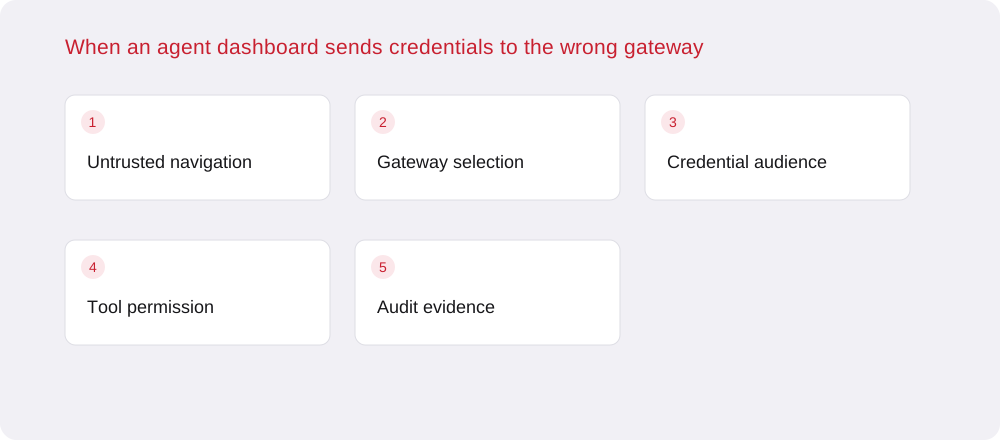
An agent dashboard can be locally hosted while still making network connections chosen by a web page. CVE-2026-25253 illustrates the distinction: the OpenClaw advisory describes a Control UI that accepted a gateway destination from its query string, connected automatically, and included a stored gateway token. A local listening address did not stop the browser from sending that credential elsewhere.
The important question is therefore not simply whether the gateway is exposed to the internet. It is whether untrusted navigation can influence the destination of a credential-bearing connection. Configuration imported through links, bookmarks, redirects, or integrations deserves the same scrutiny as an explicit login form.
Separate three capabilities during review: selecting a server, presenting a credential, and invoking a privileged tool. A URL may legitimately select a display view without being allowed to choose a new authenticated server. Combining these capabilities in one automatic initialization step makes a convenient link behave like a delegated authorization decision.
Document where the token originates, its permitted audience, its lifetime, and the actions it authorizes. A successful WebSocket handshake is not sufficient evidence of the server's identity or of permission to disclose a token. Review reconnection and fallback paths as well as the first connection.
Treat a new gateway address as a change of trust context. Validate the complete origin, including scheme, host, and port, against a deliberately configured destination. Avoid treating string prefixes or a familiar-looking hostname as proof of equivalence. User confirmation should clearly identify the new server before any existing credential is transmitted.
Where architecture permits, use separate credentials for separate gateways and avoid transferring a powerful long-lived token through browser-controlled state. Keep display preferences apart from authentication material. Restricted token scope limits consequences, but it does not repair an unsafe disclosure path.
Use an isolated test gateway that records whether an authorization field was received without storing its value. Exercise a normal connection, an unexpected destination, a redirect, a reload, and a reconnection. The negative test succeeds when the unexpected server receives no credential, rather than merely when a warning appears afterward.
Also test the trusted workflow. A repair that prevents every connection may pass a security check while breaking the product. Capture destination decisions and permission transitions in logs, with sensitive fields redacted. That evidence helps distinguish a rejected navigation from a rejected privileged action.
The upstream advisory identifies 2026.1.29 as the release addressing this issue. That is a historical fix boundary, not a recommendation to remain on an old version. Operators should use a currently maintained release and verify the deployed package rather than a development checkout or an installer filename.
If a credential may already have reached an untrusted endpoint, patching alone is incomplete. Rotate the affected token, inspect privileged configuration changes and tool activity, and assess secrets accessible to the agent. Keep the incident conclusion proportional to the evidence: attempted disclosure, observed disclosure, and subsequent execution are different findings.
Configure fix approvals, protected paths, and account settings in one place.

Review findings and fix activity in one place, with finding exports available.

Review recorded scan activity and finding state changes.

Account membership controls access to connected repositories and findings.

Bring your own encryption key. Your data stays encrypted with keys you control.