
Governance
Configure fix approvals, protected paths, and account settings in one place.
Research
A defensive guide to privilege checks on migration controls, informed by the public Langfuse CVE-2025-59305 issue.
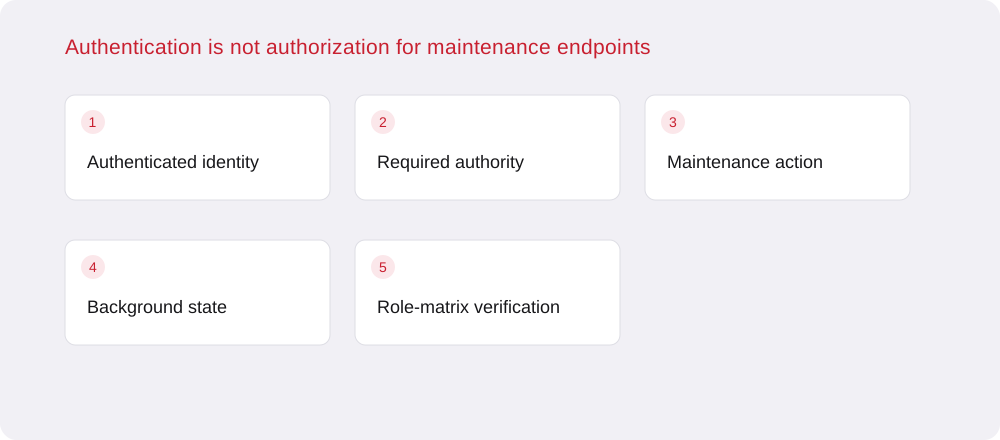
Applications often apply careful access control to normal user resources while treating internal maintenance operations as an exception. Migration status, retries, administrative utilities, and support tooling can receive weaker checks because the interface looks operational rather than customer-facing. A valid login does not establish permission to invoke those functions.
CVE-2025-59305 concerns authorization around Langfuse background-migration controls. The upstream change d67b317 revisits procedure naming and applies more explicit authorization distinctions. The useful lesson is to determine what a procedure permits, rather than assuming that a helper named protected already enforces every privilege the operation requires.
Write a permission table for each maintenance action: read status, enumerate jobs, retry work, change configuration, or start a data transformation. Identify the roles and deployment contexts that legitimately need each capability. A single authenticated-user category is often too broad for actions that can affect the whole installation.
Trace the check from the request boundary to the actual operation, including helper calls and background-job creation. A frontend that hides an administrative button is not the enforcement layer. Also check whether an alternate API transport or internal route reaches the same function without the intended permission context.
Renaming an authentication-only helper can make its meaning clearer, but naming alone is not a security control. Verify that the repaired procedure invokes the correct role, ownership, or deployment-level authorization check before it performs the action. Inspect procedures that import the same helper so the fix does not leave equivalent paths unchanged.
Preserve legitimate operational access as well. An administrator who can inspect a task may not necessarily be allowed to retry it in every deployment. Separate read and mutation permissions where the product's model requires that distinction, and document the expected error for an authenticated but insufficiently privileged caller.
Use synthetic test identities representing an unauthenticated caller, an ordinary member, a scoped administrator, and any required installation-level operator. Exercise each allowed and denied action against the real API boundary in an isolated environment. Assert that denied requests cause no job creation or state transition, not merely that the response body contains an error.
Include direct API calls because UI tests can miss authorization that is only enforced by presentation. Keep the test data small and disposable. For operations involving migrations or retries, inspect both the immediate response and the asynchronous state so a rejected request cannot quietly schedule work anyway.
Use the upstream source change and current vendor guidance to establish whether the deployed server includes the repair. Do not substitute an unrelated client-library version for the server revision. Dependency records can refer to different packages with similar names, so the affected component must be identified explicitly.
After deployment, review access logs and maintenance-job history for unexpected use, while avoiding assumptions that every failed call proves exploitation. The remediation record should state the permission invariant, deployed code identity, and observed test outcomes. This turns a broad claim that an endpoint is protected into a concrete, reviewable statement about who may perform which operation.
Configure fix approvals, protected paths, and account settings in one place.

Review findings and fix activity in one place, with finding exports available.

Review recorded scan activity and finding state changes.

Account membership controls access to connected repositories and findings.

Bring your own encryption key. Your data stays encrypted with keys you control.