
Governance
Configure fix approvals, protected paths, and account settings in one place.
Research
How to assess security-focused training without assuming that a specialized model is safer, more accurate, or universally better.
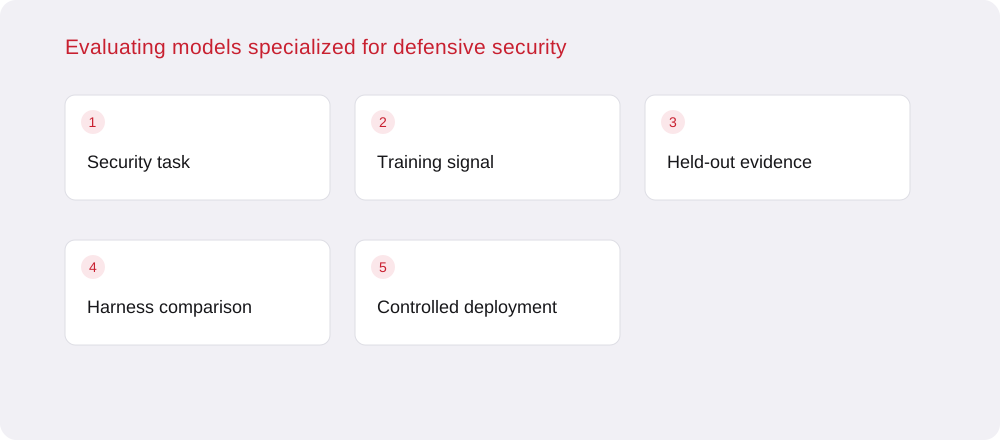
A model described as security-specialized may be optimized for several different behaviors: finding suspicious code, explaining exploitability conditions, generating a repair, or using tools to investigate a repository. These are related tasks, but success on one does not establish competence on the others. Begin with the decision the model will help a team make.
Define the expected evidence and the cost of an incorrect answer. A triage assistant can expose uncertainty for a reviewer, while an automatic remediation workflow needs stronger verification before changing software. The evaluation should reflect that difference rather than treating every security-related completion as the same capability.
Specialization can involve supervised examples, preference feedback, reinforcement learning, or additional domain material. The relevant question is which behavior those signals reward. A dataset containing polished vulnerability explanations may teach convincing reporting without teaching reliable reproduction, while patch examples may overrepresent simple changes that are easy to score.
Ask how evaluation tasks were separated from training data and model selection. Public advisories and familiar codebases can create contamination risks even without intentional copying. A useful report describes the split and its limitations; it does not treat a high result on a repeatedly inspected set as evidence of generalization to new systems.
A security model should be able to say that a required fact is missing. Measure whether it distinguishes a plausible weakness from a confirmed reachable vulnerability and whether it revises its conclusion when configuration or runtime evidence changes. Reporting every suspicious pattern as critical can look active while imposing substantial reviewer cost.
Include negative controls that preserve the surrounding complexity: an authorized role, a correctly constrained path, or a version containing the relevant fix. Evaluate the quality of the explanation, affected scope, and verification artifact. A label-only answer can conceal whether the model reached the conclusion for the right reason.
Keep tool availability, context retrieval, token limits, and execution permissions constant when comparing models. If one model receives a runnable environment and another only a snippet, the comparison mixes model capability with system design. Record failures and unsupported environments rather than discarding them silently.
Measure cost and latency at the workflow level. A specialized model may produce a useful candidate quickly but require a separate validator; another may be slower while reducing follow-up work. Compare the complete path to a reviewed finding or accepted repair, including repeated runs and the effort needed to resolve conflicting outputs.
Before using a model for consequential security actions, replay representative internal cases and require evidence at the same boundary the production workflow will use. Keep permissions and rollback independent of the model's confidence. Version model choices and prompts so a regression can be tied to a concrete change rather than an indistinct platform update.
The NIST AI Risk Management Framework and established task-based evaluation research provide useful measurement references. This article does not announce a Counterswarm-trained model or publish inherited performance results. It provides a defensible process for deciding whether a security-focused model improves a particular defensive workflow, under stated tools, budgets, and review requirements.
Configure fix approvals, protected paths, and account settings in one place.

Review findings and fix activity in one place, with finding exports available.

Review recorded scan activity and finding state changes.

Account membership controls access to connected repositories and findings.

Bring your own encryption key. Your data stays encrypted with keys you control.